
A common objection to universalism (the view that all people will eventually be reconciled to God) is that it violates our free will — that in order for God to save everyone, he would have to force some to love him. Those who argue from that point of view disavow universalism in part because they believe that some people will freely choose to reject — and will always choose to reject — God’s saving love and grace.
But are we truly as free as we think we are? And does our perceived freedom really allow us to reject God’s love? All things being equal, perhaps we could make a truly free choice between condition A and condition B. But things are never equal — there are always constraining factors that push us in one direction or the other. When it comes to universalism, it might be easy to say that some will be able to freely reject God’s love — but when faced directly with the most pure, perfect, absolute love imaginable the actual possibility of such a rejection might just be so small that it’s virtually non-existent.
Our free will is “violated” all the time. I don’t have a choice to believe that there’s a mug of hot coffee beside me or that the sun is shining outside. These things simply are — I perceive them immediately and directly and accept them as true without the need to ponder them and weigh the evidence for them and make a choice whether or not to accept them. I simply know that the coffee is hot and the sun is bright and my knowledge of those facts shapes my subsequent actions. Try as I might, I can’t freely will the coffee out of existence or the sun to darken. Isn’t it possible that our experience of God’s perfect love will be similarly self-evident?
But might some still choose to reject that love, just as one can choose not to drink a mug of coffee or not to step outside and enjoy the summer day?
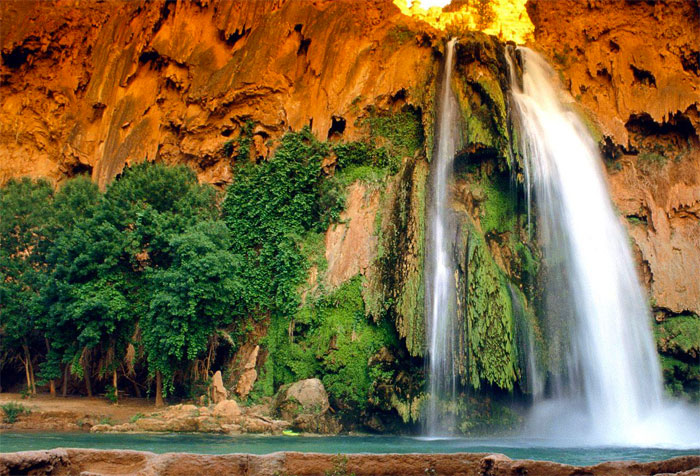
Say you’ve been trekking across a parched and barren desert for days, that you’re sunburned, your lips are dry and cracked, your eyes hurt from the glare of sand, your feet are dirty and blistered, your muscles ache and you feel as if you can barely go on. And then you come around a bend in the path and there before you is a shady grove of trees surrounding a pool of cool, clear water. A waterfall splashes down the rocks. A table beside the pool is filled with a delectable selection of fruit. A hammock sways gently in the breeze. A sign hangs from a tree with the words “Rest for weary travelers: free food and water, help yourself!”
Do you stop and think about what you’ve encountered? Do you weigh the pros and cons and evaluate the long-term consequences of your decision? Do you decide that maybe it’s not such a good opportunity to quench your thirst and that you’d rather keep trekking across the desert? Or do you avail yourself of the refreshment before you? And if you do so, has your free will been trampled over?
Perhaps we can concoct circumstances where someone would pass by this oasis: they might think it’s a mirage, or that there’s a bigger, better rest spot further down the road, or that they don’t deserve such a wonderful rest, etc.
Perhaps. But it seems to me far more likely that virtually all people, when given the opportunity for respite from their journey and salvation from death in the dessert, would, without regards for sacrosanct notions of free will, happily step from the hot sand into the cool, refreshing shade.


Leave a Reply to AnnaCancel reply