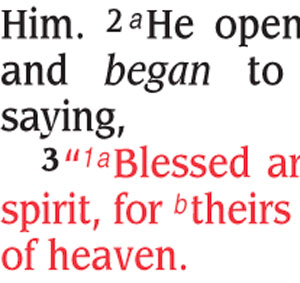
 I’m not a Red Letter Christian. By this I don’t mean I’m opposed to Tony Campolo’s and Jim Wallis’ Christians-for-social-justice movement. I mean it in a very literal sense: I don’t like red text in my Bible.
Red letter Bibles print the words of Jesus in red, presumably so that we can better focus on his very important teachings . It’s the theological equivalent of underlining important passages in a textbook so that you can go back and quickly study them before an exam. As Christians, what could be more important than the teachings of Jesus? But for such a ubiquitous convention, it’s notable that red letter Bibles are a relatively new concoction; the first one was printed in 1899, but since then they’ve become the de-facto standard for American Evangelicals.
There are three reasons why I’m opposed to this convention:
- Linguistically, the quotations from Jesus in the Bible aren’t even his exact words. Jesus didn’t speak English — his primary language was Aramaic. He may have known Hebrew and Greek, but his day-to-day speaking and teaching were in Aramaic. So even if we knew what Jesus’ precise words in Aramaic were, the English words we’re highlighting in red are merely a translation, and all translation necessarily involves paraphrase and interpretation. But we don’t have his precise words — the Gospels were written in Greek, not Aramaic, and even a cursory comparison between the Gospels reveals disagreements on wording. Furthermore, the Gospels were written quite some time after Jesus’ public ministry; they weren’t intended to provide exact word-for-word transcripts, but instead they (hopefully) capture Jesus’ ideas. To highlight words in red as if they are a magical incantation straight from the mouth of God is to deny the historical and textual evidence.
- Typographically: red letters are difficult to read. Every other book in the world prints all its text in black, and there’s a good reason they do so: black text on white paper is easy to read. Red text is just plain hard on the eyes. And to compound matters, the red used in many Bibles is often more pink or orange than red. A river of pink running down the page, set in what is already a barely readable font on semi-transparent paper, does not make for a pleasant reading experience. Which of these two is easier to read?

- Theologically, are the words of Jesus really more important than the rest of the text? Why do we have the entire Bible, most of which isn’t Jesus’ teachings, if his words are what’s truly important? Why don’t we just trim out all the rest and carry around a “Sayings of Jesus” pamphlet? Christianity is not simply based on the sayings of Jesus, it’s not just about following his teachings. Jesus wasn’t just a charismatic teacher who we should pay attention to and seek to emulate. To reduce Christianity to merely the words of Jesus, or to highlight those words over and above the rest of the Bible, is to distort and diminish the work of God throughout history and ultimately waters-down and even obscures the message of the Gospel. I’m not saying the words of Jesus aren’t enormously important. But we need to carefully ask ourselves: are they truly more important than the other words in the Bible?
If you have a red letter Bible and are happy with it, then by all means continue to use it. But the next time you’re considering purchasing a Bible, take the time to see what black letter editions are available.
For more on the history of red letter Bibles, visit http://www.crossway.org/blog/2006/03/red-letter-origin/.
For further discussion of red letter Bibles from a design perspective, visit http://www.bibledesignblog.com/2009/03/red-letter-bibles.html.


Leave a Reply to DanCancel reply