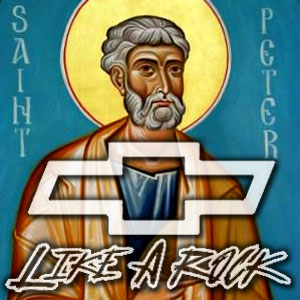

In light of Pope Benedict’s abdication, it seems relevant to take a look at one of the verses often understood as relating to the papacy, Matthew 16.18: “And I tell you that you are Peter, and on this rock I will build my church, and the gates of Hades will not overcome it.”
The NIV note provides some helpful clarification: “The Greek word for Peter means rock.” You can see this in the Greek: κἀγὼ δέ σοι λέγω ὅτι σὺ εἶ Πέτρος, καὶ ἐπὶ ταύτῃ τῇ πέτρᾳ οἰκοδομήσω μου τὴν ἐκκλησίαν καὶ πύλαι ᾅδου οὐ κατισχύσουσιν αὐτῆς.
Unfortunately, many conservative Protestant commentators go to extraordinary lengths to avoid the clear meaning of this verse. Such tortured exegesis often involves trying to glean subtle geological differences between Πέτρος and πέτρᾳ: one means big boulder, one means little stone, one means rock outcropping, one means pebble and on and on. But these subtle distinctions fade away when one realizes that Jesus would have said these original words in Aramaic, where Peter’s name is exactly the same as the word “rock”: כֵּיפָא/Κηφᾶς/kepha’. How do we know this? The Gospel of John spells it out: “And he brought him to Jesus. Jesus looked at him and said, ‘You are Simon son of John. You will be called Cephas’ (which, when translated, is Peter)” (John 1.42). Again, the NIV note is helpful, explaining that “Cephas (Aramaic) and Peter (Greek) both mean rock.”
Alternatively, some claim that the “rock” Jesus refers to is Peter’s faith, or to Jesus himself. But such readings fail to offer a better alternative than the straightforward reading of “Peter” as the antecedent of “this rock.” There’s a reason for the wordplay Jesus employs here — it’s not to offer an opaque theological diversion, it’s to make a clear point about the future role of one of his disciples.
Matthew 16.18 is really just saying “And I tell you that you are Rock and on this rock I will build my church.” So what does Jesus mean? Simply that Peter will play a foundational role in the building of the church and that Peter’s leadership will be crucial in the early church — and history bears out the truth of Jesus’ statement.
Does all this mean that Peter was the first Pope? Or that the Roman Catholic understanding of the role and authority of the papacy is true? Not necessarily. For that understanding one must look beyond this verse and beyond the Biblical text itself. But unfounded fear of Catholic theology shouldn’t prevent one from recognizing Peter’s important place among the disciples, his special relationship with Jesus and his role as the Rock upon which Jesus built the Church.


Leave a Reply to dgsgCancel reply