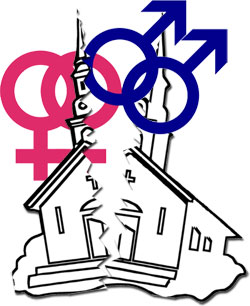
 Is there currently a more divisive issue within Christianity than that of homosexuality? Sure there are plenty of other issues that Christians fight about, but of all the topics mentioned in my post “Can you be a Christian and still believe … ?”, homosexuality and abortion easily garnered the most attention. And though abortion is undoubtedly a contentious issue, Christendom stands in virtually unanimous opposition to it — the discussion there is largely regarding the extent to which the practice should be legally regulated or fully prohibited.
But homosexuality — is this the key issue in what some have labeled a New Reformation? Are we in the middle of a foundational schism? Or will this issue fade into irrelevancy as time passes, just as slavery (at least in the Western world) is now only a sad memory from the past?
On the one side are those who believe that the Bible clearly and unequivocally condemns homosexual practice as sinful and that to believe otherwise places one outside the boundaries of orthodoxy, firmly in the realm of heresy and anathema.
On the other side are those who argue that homosexuality isn’t necessarily sinful and that practicing homosexuals should be given full inclusion in the Church. They argue that, just as with slavery, the Bible is being distorted and misused in order to marginalize a specific group of people.
And there are those who try to hold an awkward middle ground, declaring that homosexuality per se isn’t sinful, but homosexual practice is, so celibacy is the sole non-sinful option for homosexuals (this is seemingly the current position of the new Archbishop of Canterbury, Justin Welby).
What will come of all this? Only time will tell — it is extraordinarily difficult to make predictions about outcomes when one is still in the midst of such rapidly shifting ground.
Will we continue to see denominational fractures, with “welcoming and affirming” groups breaking off from those who wish to hold their ground, each side digging in further, unwilling to entertain ideas of change or compromise?
Will those who nobly (and perhaps naively) proclaim the middle ground have any significant role in these changes? Or will their message of “let’s just all get along” ring with increasing hollowness?
Will the weight of the Church gradually shift towards a new understanding, so that in later years this controversy will be little more than a footnote in Christian history?
Some look upon the prospect of a New Reformation with delight: the Church can finally shed her outdated ways and move on to better things, now able to fully exhibit God’s love without the encumbrance of conservative theology. But the first Reformation wasn’t all green pastures of freedom with two sides amicably parting ways. It entailed horrid bloodshed and persecution — rancor, mistrust and suspicion between Protestants and Catholics still reverberate through the Church to this day.
Some have declared the “gay war” essentially won, but from my perspective this is a bit like declaring victory in the Vietnam war after the Battle of la Drang. Yes, there have been “victories” for all sides, but I don’t think either side will ever truly “win.” Perhaps I’m overly pessimistic, but I see too little common ground, too good of arguments (on both sides) and too much at stake for either side to make any significant concessions. At best I think we will see an uneasy détente — each side tolerating, but certainly not embracing, the other.
In the end, what is important is how we deal with this issue on an individual, personal level. Do we ignore it and hope it eventually just resolves itself? Do we take up arms against this sea of theological trouble and try to enact significant change? Do we decline to take a stance and just proclaim God’s love?
I don’t have any easy answers, but I do think we must seek to remain true to God’s love, be sensitive to those with differing beliefs on contentious issues and be cautious about “digging in” too deeply in defense of our existing positions.


Leave a Reply to Ellen K.Cancel reply