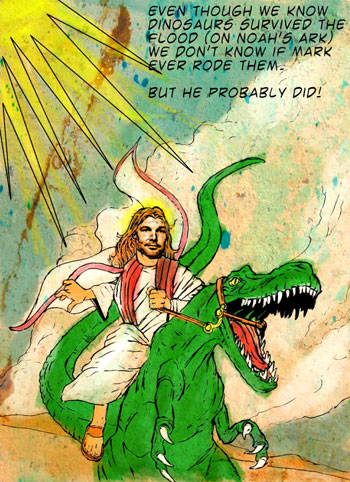

In response to my previous post about Mark Driscoll, a commenter on reddit referenced Mark Driscoll’s and Gerry Breshears’ book, Doctrine: What Christians Should Believe. (Hereafter I’ll simply reference Driscoll as the author).
About that book, another commenter said “In one chapter it plainly stated that the majority of scientists agree that human beings arose about 10,000 years ago.”
Not one to simply accept an anonymous comment on the internet as truth, I decided to see for myself what Driscoll said about evolution in his book. Among many questionable assertions and conclusions, these quotes seemed particularly problematic:
- “The scientific data completely agrees with Genesis on the impossibility of one species evolving into another.” (92)
- “Even the most conservative Bible scholars and the most unbelieving naturalist scientists agree that human life as we know it is, at most, roughly ten thousand years old.” (97)
- “Christians are not free to accept the yet unproven and highly suspect thesis of naturalistic and atheistic macro-evolution — that one species can evolve into another species entirely.” (98)
- “Macro-evolution purports that evolution happened over long periods of time without transitional forms in the fossil record. If evolution were true, there would be numerous transitional forms of human life in the fossil record that would, to some degree, reflect the evolutionary chart that many were subjected to growing up in school. Yet, the absence of transitional fossil forms is simply yet another evidence of the fact that macro-evolution did not occur.” (102)
I almost feel no need to directly address these statements because they seem so obviously false. But in case there’s some doubt:
- The exact opposite is true: the scientific data completely agrees not only that it’s possible, but also that macro-evolution has happened. Refer to any modern book on evolution.
- The overwhelming majority of scientists (Christian and non-Christian) agree that homo sapiens came onto the scene roughly 100,000 to 200,000 years ago. The oldest human fossils we have are about 195,000 years old and mitochondrial Eve lived about 200,000 years ago.
- Despite acknowledging that some “Bible-believing Christians” hold to theistic evolution, Driscoll nevertheless maintains that Christians are not free to hold such a view. For him, theistic evolution “inherits all the scientific impossibilities of evolution as a theory of origins.” (91) There’s simply no middle ground. One wonders what the practical outworking of this lack of freedom is?
- The “lack of transitional fossils” argument is an old canard that simply isn’t true. There are transitional fossils that do provide evidence of evolution! Here’s an easy-to-understand video from BioLogos that offers an explanation .
Driscoll says that one’s views on creation and evolution shouldn’t be a “litmus test for Christian orthodoxy” and “ongoing spirited study and discussion can be helpful to God’s people.” (93) But practically speaking, he leaves little room for irenic disagreement. Not only is he sadly misinformed about the facts of evolution (or deliberately deceptive?), he views the “hypothesis of evolution” as Biblically and scientifically “impossible.” Where’s the room for spirited discussion when you’ve already decided that there’s no room for the possibility of agreement?
If you want to believe in Christianity and reject evolution, fine. But please don’t burden me with scientifically naïve and theologically biased doublespeak that pretends to be generous about “open-handed” issues while grounding one’s defense of a particular position in a “close-handed” understanding of inspired and inerrant Biblical authority:
Within Christian theology there are open- and closed-handed issues. Biblical authority is a closed-handed issue. Christians receive what the Bible actually teaches as truth from God to be believed and obeyed. (81)
For Driscoll, what the Bible “actually teaches” is “the possibility of an old earth, six literal days of creation, and a young humanity on the old earth.” (90) And to disagree with that viewpoint — especially in the form of theistic or naturalistic evolution — places one squarely outside the bounds of Christian orthodoxy and firmly in the grip of atheistic naturalism:
Indeed the only logical option apart from the biblical doctrine of creation is ‘the firm foundation of the unyielding despair.’ (105)
From there it’s but a short step to a completely nihilistic worldview:
People who do not understand the doctrine of creation and the doctrines that relate to it want to die. (106)
Ironically, he counters this nihilism with a lengthy quote from N.T. Wright, who holds an understanding of the Genesis creation account that is decidedly different from Driscoll’s own.
On the surface, Driscoll’s explanation of the issues surrounding evolution and creation seems far less extreme than some viewpoints. But his pretense of accurately presenting the varying positions ultimately does an even greater disservice to Christians. A house of cards, no matter how carefully constructed and ardently defended, is still only one strong wind gust away from complete collapse.
Christians who bolsters their faith with the “scientific truth” regarding lack of transitional fossils and the young age of homo sapiens as well as the “biblical truth” of a literal six day creation are in for a surprise when they encounter the robust scientific evidence for evolution and the thoughtful, nuanced theology of those Christians who accept it.


Leave a Reply