 Any discussion of women’s roles in the church must take into account the apostle Junia. Paul writes in Romans 16.7, “Greet Andronicus and Junia, my fellow Jews who have been in prison with me. They are outstanding among the apostles, and they were in Christ before I was” (NIV2011). Though generally accepted as a female apostle throughout church history, Junia has fallen on hard times since the Reformation: her gender has been changed (to the male Junias in the NASB, NIV1984, RSV, UBS4 and NA27) and more recently her apostleship has been questioned. (more…)
Category: Theology
-

Junia the Apostle
-

Partakers of the Holy Spirit
 “For it is impossible in the case of those who have once been enlightened, tasted the heavenly gift, become partakers of the Holy Spirit, tasted the good word of God and the miracles of the coming age, and then have committed apostasy, to renew them again to repentance, since they are crucifying the Son of God for themselves all over again and holding him up to contempt.” (Heb 6:4–6 NET)
This passages is a rich source for theological controversy and exegetical exploration, but I’m going to focus on only one word from verse four: partakers, or in Greek, μέτοχος. One tiny piece of the puzzle in regards to this passage is whether “partakers of the Holy Spirit” is describing a saved, regenerate person, or whether it could be describing a non-Christian who is merely the recipient of some benefits associated with the Holy Spirit. (more…)
-
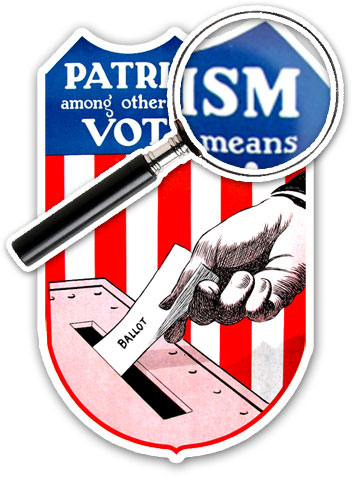
Post-Election Perspective
 Post-election, regardless of the results, it’s important to keep things in the proper perspective:
Matthew 28.18
Then Jesus came up and said to them, “All authority in heaven and on earth has been given to me.”
Romans 13.1
Let every person be subject to the governing authorities. For there is no authority except by God’s appointment, and the authorities that exist have been instituted by God.
1 Peter 2.13−17
Be subject to every human institution for the Lord’s sake, whether to a king as supreme or to governors as those he commissions to punish wrongdoers and praise those who do good. For God wants you to silence the ignorance of foolish people by doing good. Live as free people, not using your freedom as a pretext for evil, but as God’s slaves. Honor all people, love the family of believers, fear God, honor the king.
Regardless of who we voted for and who won, we have a responsibility to submit to governmental authority — an authority that was put in place by God. And when we encounter those with whom we disagree, politically or otherwise, how are we to respond to such “ignorance of foolish people”? By doing good. Not by arguing with them or ridiculing them, not by reveling in victory or wallowing in defeat, not by withdrawing from discussion and not by merely accommodating opposing views at the expense of our own beliefs — no, we are to do good by reflecting God’s love for the world through our lives.
-

Why Are You A Christian?
 Something Dr. Norman Ericson said many years ago has always stuck with me. Although I don’t remember his precise words, it was essentially this: “Why are you a Christian? For most of us, it’s because our parents were Christians, and because their parents were Christians and so on. Our faith was passed down to us by our families. And that’s ok. It’s ok to embrace the faith of your family.” (more…)
 -

Rebuke Him!
 Christians often cite Luke 17.3 as commanding us to condemn sin in the lives of other Christians: “If your brother sins, rebuke him.” This is sometimes followed by a reference to Ephesians 4.15, where we are admonished to “speak the truth in love.” Given these clear teachings, Christians are to eschew timid tolerance in favor of boldly confronting the sin in our fellow Christian’s lives. We are responsible for holding one another accountable for our actions and we are remiss if we let obvious transgressions go unchallenged. Surely if we had some unknown sin in our own life we would want to be told about it — so we have a Christian obligation to do the same when we see sin in others.
Or possibly not. (more…)
-
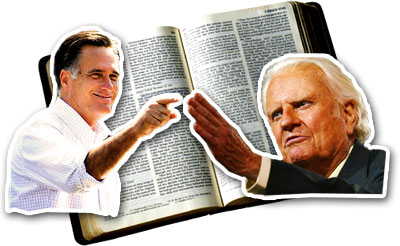
Vote Biblical Values
 Billy Graham entered the political fray last week with a Vote Biblical Values campaign. While not endorsing a specific candidate, he does provide some helpful voting tips:
I believe it is vitally important that we cast our ballots for candidates who base their decisions on biblical principles and support the nation of Israel. I urge you to vote for those who protect the sanctity of life and support the biblical definition of marriage between a man and a woman. Vote for biblical values this November 6, and pray with me that America will remain one nation under God.
-

Love vs. The Bible
 I’d like to take a more focused look at one of the criticisms I discussed in my post All You Need Is Love. Specifically, progressive Christians are often accused of overlooking, ignoring, tolerating and even accepting clearly sinful behavior because of their infatuation with love. This is perhaps no more evident than in the ongoing debate within Christianity regarding homosexuality. (more…)
 -

Eunuchs For The Sake Of The Kingdom Of Heaven
 “For there are some eunuchs who were that way from birth, and some who were made eunuchs by others, and some who became eunuchs for the sake of the kingdom of heaven. The one who is able to accept this should accept it.” Matthew 19.12
I’ve always assumed that “made themselves eunuchs for the sake of the kingdom of heaven” was metaphorical rather than literal language and that Origen was sadly misguided in his understanding of that text. But just because we don’t want something to be literal doesn’t mean we should just assume it isn’t. Throughout history there have always been some Christians who understood this text as a literal command to physically castrate themselves — is there a possibility that they’ve been right? (more…)
-
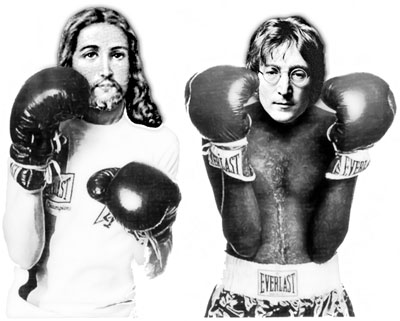
All You Need Is Love
 One criticism that I’ve heard leveled against progressive (liberal!) Christians is that they have an “all you need is love” theology — that they essentially neglect the Gospel, overlook sin and ignore God in favor of vague platitudes that advocate peace and love at the expense of Christian orthodoxy.
If one understands this position as strictly reductive (i.e. you need nothing other than love), then yes, such a statement is indeed problematic. (more…)
-

Why Not Vine’s?
 I regularly encounter citations of outdated Biblical reference material: a friend recently sent me an article that referenced definitions from Grimm’s Greek-English Lexicon, another friend has cited entries from Vine’s Complete Expository Dictionary of Old and New Testament Words and Strong’s Concordance is frequently used in sermons to give us the meaning of the original languages.
So what’s wrong with these sources? Using biblical reference works of the past is like seeking medical advice from a 19th century medical dictionary. Would you feel comfortable if your doctor flipped open the 1858 edition of Gray’s Anatomy while he poked and prodded you? (more…)
