Category: Theology

  • Does universalism subvert free will?

    Does universalism subvert free will?

    Salvation?

    A common objection to universalism (the view that all people will eventually be reconciled to God) is that it violates our free will — that in order for God to save everyone, he would have to force some to love him. Those who argue from that point of view disavow universalism in part because they believe that some people will freely choose to reject — and will always choose to reject — God’s saving love and grace.
    (more…)

  • Some thoughts on evangelicalism

    Some thoughts on evangelicalism

    Evangelical?

    In an earlier post, I asked “Why are you or why aren’t you an evangelical Christian?” I received some great, thought-provoking responses, and several people asked for some specifics about my answer to that question. So here goes!

    • For me, evangelicalism means living a Gospel-centered life. The Gospel is the Good News that Christ died for our sins and rose again. It is the recognition and confession that Jesus is Lord and it is living out my life in light of that fact.
    • For me, evangelicalism means living a life that is Christ-centered and cross-centered. Jesus stands at the center of Christianity and his atonement on the cross stands at the center of Jesus’ life.
    • For me, evangelicalism recognizes the importance of the Bible. The Bible offers us invaluable wisdom and insight about our faith and God’s redemptive plan for humanity. We should take what it has to say extraordinarily seriously, seeking to properly understand the messages contained in its pages.
    • For me, evangelicalism means cultural engagement. Christians are not generally called to live separate, cloistered lives, nor are they supposed to live at antagonistic odds with society. Rather, we should strive to be an active part of culture and society. Our faith should inform who we are and how we interact with others.
    • For me, evangelicalism is mission-oriented. We are called to act. Not to sit idly by, not to only look out for ourselves, but to act in the world, expressing God’s love wherever we can, caring for the sick and the poor and the downtrodden, proclaiming the gospel through our words and our deeds.

    I understand how all of these facets can be taken to unhelpful and even dangerous extremes. I realize that American evangelicalism has often been particularly negligent in that regard and regularly expresses hate and judgment in place of compassion and grace. But, for me, the characteristics I outlined above stand at the very heart of Christianity — every use of the word “evangelical” can be changed to the word “Christian.”

    That’s how I understand evangelicalism. But … that’s clearly not how many others understand it. For them, evangelicalism has to do with forcibly evangelizing, with drawing up battle lines, with defining in and out groups, with rooting out heresy, with condemning others to hell, with vehemently opposing abortion and homosexuality, with standing up for gun rights and with supporting a generally Republican agenda. For many, the term evangelical is a synonymous with a “brand” of Christianity that bears little, if any, resemblance to the Christianity that I believe in.

    I’ve always self-identified as an evangelical because that was the tradition I was brought up in and because it seemed to me to best fit my understanding of what I believe. But identifying as such puts me in the same room as many other self-proclaimed evangelicals with whom I share very little theological common ground.

    To the extent that this discussion is about arbitrary theological delineations, it is perhaps a futile undertaking to try and pin down any specific meaning for the term evangelical. But this has very practical implications for me: I do get asked what religion I am, I do get asked what kind of Christian I am. I don’t need or particularly want to place myself in a box with clearly defined borders. But I do want to respond to those sorts of questions in the most honest and accurate way possible. It’s becoming increasingly obvious to me that “Evangelical Christian” is perhaps not a useful term of self-identification, at least not without a great deal of potentially tedious explanation. 

    On the other hand, I think that self-identifying as evangelical while making it abundantly clear that my stance on a number of controversial issues falls to the (far?) left of the ideological spectrum potentially offers a powerful witness about the compatibility of Christianity with overt support for traditionally “liberal” issues. From my perspective, there isn’t necessarily any conflict between a deep love of the Jesus and the Bible and support for gay rights, women’s rights and a slew of other issues.

    Am I an evangelical? Yes! What exactly does that mean to me and to you? Let’s sit down and have a conversation about it …

  • Lexical Lies and Dictionary Deceptions

    Lexical Lies and Dictionary Deceptions

    Red light

    In a recent online discussion regarding the Bible and homosexuality, one participant brought up the fact that Jesus never directly addressed the issue of homosexuality. To my surprise, another participant claimed that Jesus most certainly did condemn homosexuality in Matthew 15.19: “For out of the heart come evil intentions, murder, adultery, fornication, theft, false witness, slander.” (NRSV)

    This person claimed that “fornication,” or πορνεία in Greek, specifically includes homosexuality and cited Thayer’s Greek Lexicon as defining πορνεία as: “adultery, fornication, homosexuality, lesbianism, intercourse with animals etc.”

    (more…)

  • An Atheist Monument To?

    An Atheist Monument To?

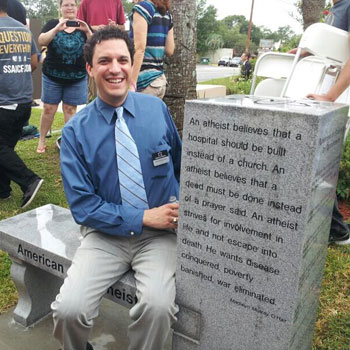
    Atheist Monument

    The American Atheists unveiled a public monument in Florida today and have plans to build more around the country.

    When I first heard this story I wondered, a monument to what? To no-god? To non-belief? Monuments usually stand for something, not for not-something. Wouldn’t it be more appropriate to erect a monument to science, or to reason, or to humanity or to nature? This is part of the problem with modern militant atheism: it all too often defines itself not with positive truth claims, but rather solely in opposition to vague and stereotypical notions of religions belief. Sure, “secular humanism” and “metaphysical naturalism” don’t have the same firecracker snap of “atheism,” but for a movement that purports to value truth over ideology, it seems like you’d want to make it explicitly clear from the outset precisely what you stand for. To borrow a trick from the atheist playbook: erecting a monument to atheism makes about as much sense as erecting a monument to non-stamp collecting. (more…)

  • Why Are/Aren’t You An Evangelical Christian?

    Why Are/Aren’t You An Evangelical Christian?

    Evangelical Christian?

    The title of this post is an honest question that I’d like to hear your answer to: why are you or why aren’t you an evangelical Christian? 

    What does the term “evangelical Christian” mean to you? Is it a useful distinction that clarifies theological positions, or is it merely a word that furthers divisiveness? 

    If you don’t consider yourself to be an evangelical, what does it mean to you to be a Christian? How do you define your Christianity in a way that excludes evangelical distinctives but still holds true to positive statements of faith? 

    If you do consider yourself to be an evangelical, how do you understand your faith in relation to non-evangelical Christians? What makes you different? What makes you the same?

    I think that all Christians are (or should be) evangelical … and the more I think about it, the less I see a way of being a Christian that isn’t evangelical. But I understand that term means many things to many people and is often encumbered by an enormous amount of baggage. And, when it is used to label a particular “brand” of Christianity, it is often entirely unhelpful in delineating essential differences. It either becomes a pejorative used to marginalize someone on the far right of the theological spectrum, or it is little more than synonym for “true, Bible-believing” Christian, as opposed to the so-called “Christians” whose liberalism destines them to hell.

    So, for all three of my readers, what are your responses to these questions?

    *Also see my follow-up post: Some thoughts on evangelicalism.

  • I’m a feminist because

    I’m a feminist because

    Feminism

    I’m a feminist because

    • Women are created in the image of God and have inherent value. They deserve the same opportunities, respect, rights and freedoms that men enjoy.
    • Persistent and pernicious patriarchal oppression permeates virtually every facet of society.
    • Men have been running the show for the thousands of years and have screwed things up for long enough.
    • Our culture has marginalized and suppressed women for so long that, even given the chance, far too few women are truly empowered to take advantage of the opportunities afforded them.
    • The Internet, for all its promise of unfettered expression, is still only a reflection of our societal shortcomings regarding gender issues.
    • Whether in movies or television or music or advertising, women are objectified and sexualized and used to sell and market and promote.
    • Women are recognized more often for their outward appearance rather than their inner beauty.
    • Our culture, even when pretending to defy stereotypes, still reinforces them.
    • Stereotypes are bullshit: I know men that excel at cooking and knitting and are stay-at-home dads and love fashion and paint watercolors. And I know women who fish and hunt and drink beer and burp and work with power tools.

    (more…)

  • Universal Pope?

    Universal Pope?

    Universal Pope

    Pope Francis has garnered quite a bit of attention for his comments last Wednesday regarding atheists and his claim that everyone is redeemed by the blood of Christ. He said, in part:

    The Lord has redeemed all of us, all of us, with the Blood of Christ: all of us, not just Catholics. Everyone! “Father, the atheists?” Even the atheists. Everyone! And this Blood makes us children of God of the first class! We are created children in the likeness of God and the Blood of Christ has redeemed us all!

    (more…)

  • A New Recipe for Gender Roles

    A New Recipe for Gender Roles

    Trevin Wax recently wrote a blog post entitled The Crazy Culture of Complementarianism. He leads off with the pithy observation that “Right beliefs do not always lead to healthy cultures” and then goes on to discuss some of the “crazy” results of complementarianism that he’s noticed, such as the “unexpressed expectation that the godliest women have quiet and introverted personality types, and cannot be assertive and outgoing.”

    I applaud Wax for pointing out some of the problems that have become associated with complementarianism. But he concludes that “It’s the culture of complementarianism that needs to be renewed and restored. Because there’s nothing crazier than taking a beautiful picture of the gospel and making a new law out of it.”
    (more…)

  • Why Homosexuality Isn’t A Sin

    Why Homosexuality Isn’t A Sin

    Rothko - Pink, Gold, Red

    We all have an innate sense of right and wrong, of good and evil. We all have moral law written on our hearts. We don’t all have perfect knowledge of that moral truth and we all fall far short of living up to moral standards, but in general we recognize the universal and transcendent nature of morality.

    We know what is sin and what isn’t. We have a deep intuitional realization that murder and rape and theft are wrong. We know that when we hurt another person, whether through words or actions, we’ve done something wrong. We don’t need the Bible to tell us that, we don’t need the church to tell us that — we already know it. This is why the Bible isn’t, and doesn’t need to be, an exhaustive rule book. It’s why the Greatest Commandment resonates so deeply within us — not because it’s something we’ve never heard before, but because it’s something we already knew, whether we realized it or not.
    (more…)

  • Five good things from Mark Driscoll

    Five good things from Mark Driscoll

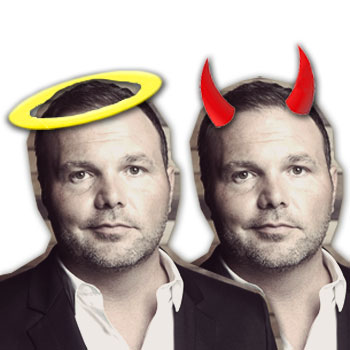
    Two Driscolls

    Recently I’ve spent a bit of time critiquing some of Mark Driscoll’s viewpoints. And while I continue to find many of his positions highly problematic, I certainly don’t think everything he has to say is bad. So I randomly chose five of his sermons and picked out a paragraph or two from each that I think are pretty darn good.

    I still have a minor quibble here and there with the views expressed in these selections, but in general I think they’re on-target. I have many more issues with the sermons in their entirety, and so in a sense some of these are taken a bit out of context. But the point is that, as much as we may disagree with someone’s style or theology or sense of humor, it’s still worthwhile to look for areas of agreement, to seek greater understanding and to work towards unity.
    (more…)