I commented to someone yesterday that I was bored and annoyed by the whole Reza Aslan controversy, so I hadn’t bothered to write about it. So in light of that disinterest, let me go ahead and add my two cents to the fray: (more…)
I commented to someone yesterday that I was bored and annoyed by the whole Reza Aslan controversy, so I hadn’t bothered to write about it. So in light of that disinterest, let me go ahead and add my two cents to the fray: (more…)
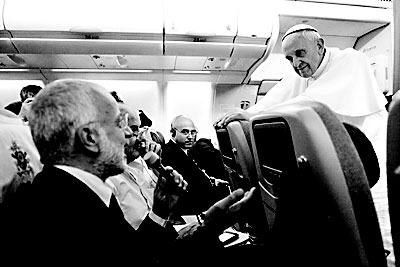

The Wall Street Journal reports this morning that in an interview Pope Francis said: “Who am I to judge a gay person of goodwill who seeks the Lord? … You can’t marginalize these people.”
This story has spread across the internet as if the Pope has said something ground-breaking about the Catholic Church’s stance on homosexuality, as if they’ve made a 180-degree about-face and are now open and accepting of gays. But nothing could be further from the truth. (more…)


The Trayvon Martin case highlighted some significant issue in the American legal system. But this wasn’t simply an isolated incident of a random miscarriage of justice.
From The Sentencing Project:
More than 60% of the people in prison are now racial and ethnic minorities. For Black males in their thirties, 1 in every 10 is in prison or jail on any given day. These trends have been intensified by the disproportionate impact of the “war on drugs,” in which two-thirds of all persons in prison for drug offenses are people of color.
From The Innocence Project:
Nearly 70 percent of the 242 people exonerated by DNA testing to date are people of color. These exonerations have spotlighted racial bias in the criminal justice system and the need for reforms that address these inequalities.
From the Bureau of Justice Statistics:
blacks were disproportionately represented among homicide victims and offenders. Blacks were six times more likely than whites to be homicide victims and seven times more likely than whites to commit homicide.
The American “justice” system is deeply broken, especially in terms of race. How many more Trayvons have to die before we take notice of these systemic problems? How much longer do we wait before implementing real change, before facing our shortcomings and honestly working together towards a solution? These problems didn’t come about overnight and neither will they easily fade away. But do we really want to wait for the media to pick the next cause célèbre for us? Or do we want to be proactive, tackling the roots of the problems head on?
When you have the highest documented incarceration rate in the world, you have a problem. And the answer to that problem isn’t more prisons, it isn’t spending more money on law enforcement, it isn’t more laws, it isn’t harsher mandatory sentencing.
The Trayvon Martin case was only the tip of the iceberg in terms of issues of race and crime in the United States. Will this be the incident that finally sinks the ship, or will we continue steaming full speed ahead, oblivious to the deadly mass of cold discord that’s lurking just below the place surface of lives?


Some thoughts and questions in light of the George Zimmerman verdict:
The American judicial system is our judicial system. If we want it to change, it’s up to us to change it. Are we willing to do so?
Despite the apparent miscarriage of justice in this case, do we really want to conduct trials in the court of public opinion? Should trials be turned into a reality TV show where we collectively vote for people’s guilt and innocence?
(more…)
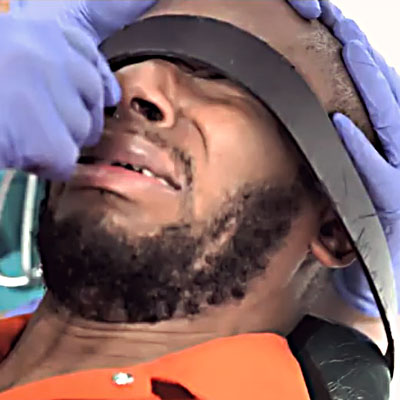
Actor and musician Yasiin Bey, aka Mos Def, recently released a video in which he undergoes the force-feeding procedure that hunger-striking prisoners at Guantanamo Bay are being subjected to. You can read a first-hand account here, or watch the video yourself:
Bey has been applauded for drawing attention to the plight of the prisoners as well as criticized for using his celebrity to sensationalize and over-simplify a complex issue. Emily Greenhouse discusses some of the controversy in her blog piece for the New Yorker.
But whether you think Bey’s contribution to this cause is substantive or not, let’s not forget the real issue regarding the situation at Guantanamo. Every attempt to marginalize or discredit Bey’s message amounts to little more than a call to ignore these facts:
The World Medical Association, in its Declaration of Tokyo, says:
Where a prisoner refuses nourishment and is considered by the physician as capable of forming an unimpaired and rational judgment concerning the consequences of such a voluntary refusal of nourishment, he or she shall not be fed artificially. The decision as to the capacity of the prisoner to form such a judgment should be confirmed by at least one other independent physician. The consequences of the refusal of nourishment shall be explained by the physician to the prisoner.
This declaration has been endorsed by the American Medical Association. AMA President Dr. Jeremy Lazarus, in a letter Defense Secretary Chuck Hagel, cites the Tokyo declaration and adds:
Every competent patient has the right to refuse medical intervention, including life-sustaining interventions
The WMA also declare, in their Declaration of Malta, that:
Forcible feeding is never ethically acceptable. Even if intended to benefit, feeding accompanied by threats, coercion, force or use of physical restraints is a form of inhuman and degrading treatment. Equally unacceptable is the forced feeding of some detainees in order to intimidate or coerce other hunger strikers to stop fasting.
In light of the declarations from the WMA, the United Nations Commission on Human Rights has said that:
treating a competent detainee without his or her consent — including force feeding — is a violation of the right to health, as well as international ethics for health professionals.
and
force-feeding of detainees on hunger strike must be assessed as amounting to torture as defined in article 1 of the Convention against Torture.
These declarations are all well and good, but they merely formally confirm what should be patently obvious to any person with a sense of morality: what’s happening at Guantanamo is deeply wrong.
The real problem with this issue is not its moral ambiguity or political intricacies, the problem is that the plight of the Guantanamo prisoners is far too easy to ignore. It doesn’t affect our lives. We don’t see it in front of us. We go about our day in a self-absorbed haze and are, generally speaking, far more concerned with what we’re going to have for lunch than with the fact that people are being strapped to a chair and forced to have lunch. We eat a hamburger while prisoners have tubes shoved down their noses.
Ignoring the problem doesn’t make it go away and doesn’t make it any less serious. If we claim to care about people, to care about their rights and their lives and their freedoms, then we can’t sit idly by while the very government that purports to stand for those freedoms blatantly abuses them. Every human life has value and until we recognize and protect that value — for all people, not just those that look like us and think like us and believe like us — we, as a country, as a culture and as a world, are settling for a second-rate society that simply isn’t sustainable. Until we properly acknowledge the importance of these issues and directly face the consequences of our national policies, we’ll continue to sacrifice the sanctity of life for selfish interests.
In the words of Mos Def from Fear Not of Man:
from my understanding people get better
when they start to understand that they are valuable
And they’re not valuable because they’ve got a whole lot of money
or ’cause somebody thinks they’re sexy
but they’re valuable ’cause they’ve been created by God
And God makes you valuable
The prisoners at Guantanamo, regardless of how they got there or what they believe, were created by God and have inherent value. When we deny that value we not only devalue them but also devalue ourselves — and, ultimately, we devalue God.
For more information, visit reprieve.org.uk and standfastforjustice.org.
It’s summer and I’m taking a bit of a hiatus from the blog. I’ll be back in a few weeks with some very big announcements! Till then …



Dulce Et Decorum Est
Wilfred Owen
Bent double, like old beggars under sacks,
Knock-kneed, coughing like hags, we cursed through sludge,
Till on the haunting flares we turned our backs
And towards our distant rest began to trudge.
Men marched asleep. Many had lost their boots
But limped on, blood-shod. All went lame; all blind;
Drunk with fatigue; deaf even to the hoots
Of tired, outstripped
Five-Nines that dropped behind.


The 17-minute 1986 documentary Heavy Metal Parking Lot records fans waiting for the start of a Judas Priest concert. Amid the myriad of colorful characters partying in the parking lot before the concert, one person stands out from even that motley crew, loudly proclaiming his love of metal music and his vitriolic disdain for punk and pop: Zebraman, so-named in recognition of his zebra-striped unitard. Zebraman’s 50-second tirade is perhaps the highlight of the short film and his character is a favorite among fans of the cult classic.
(more…)